April Durham Magzine Column
Posted: March 31, 2016 Filed under: Uncategorized Leave a comment
Every month I write a column for Durham Magazine to highlight good works and the people that do them in our community. This month my editor asked me to write about my connection to the Food Bank. What an easy assignment. No one to interview! Here is a link to the magazine online. My story is on page 16.
To make it easy, here is the story I wrote.
I can tell you that I had no idea we were going to ru story on our volunteer work at the Food Bank, because of I did I would have worn some makeup for food sorting. This is a picture with my wonderful editor and friend Andrea Cash.
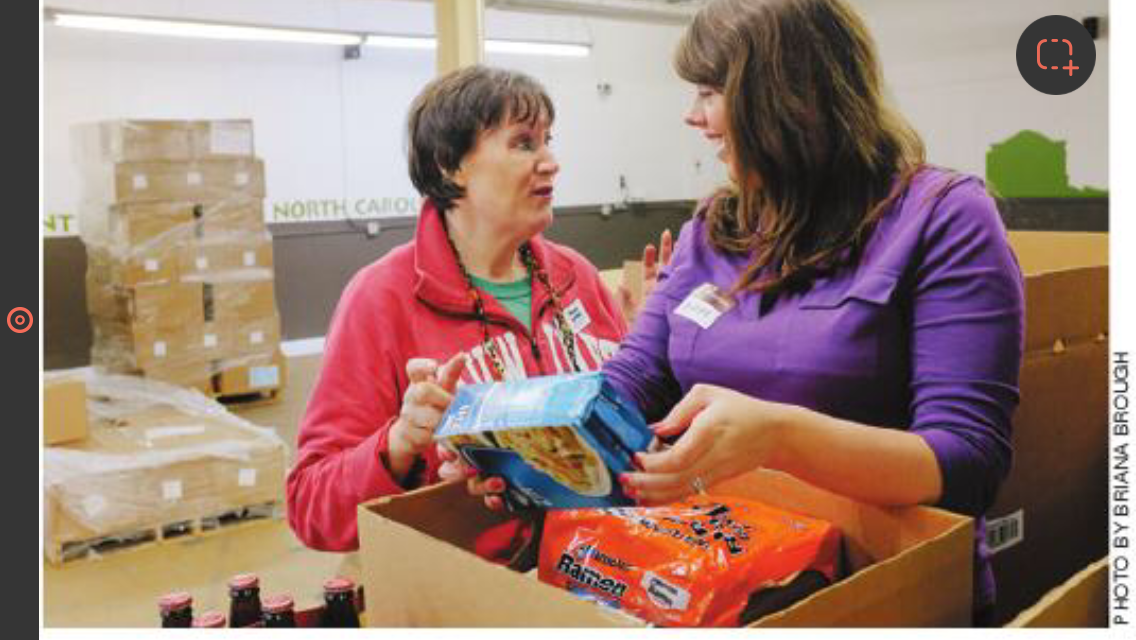
My colleagues from Durham Magazine recently joined me at the Durham Branch of the Food Bank Of Central and Eastern North Carolina for a morning of fun volunteer activities. For our writers, editors, photographer, art directors, administrative staff and sales representatives sorting food is not part of their daily routine, but certainly something they all were willing to do.
As we waited in the lobby prior to receiving our assignment for the day, one of my co-workers noticed my photo on the wall announcing they were entering the “Dana Lange Volunteer Center,” and asked me about it. The honor of having a room named for me is a boring story about being a volunteer board member for years; the real story is what got me interested in feeding hungry people in the first place.
Thirty years ago, when I was young and energetic, having just one job was not enough for me, so I had a catering business on the side. I always loved feeding people and throwing parties, which made it the perfect way to supplement my income. I was living in Washington, DC and I often threw leftover catering food away in my rolling trashcan in the alley behind my garage.
One day, as I was bringing more garbage to the can I met a man, dressed in khakis and a blue blazer, who was standing by my bin. “You have the best garbage in all of DC,” he said to me. I was a little taken aback by this greeting. Awkwardly my response was, “Thank you.”
That was when I took a closer look at him and noticed that his clothes were a little dirty, with strings hanging from the cuffs of his pants. His hair needed to be washed and his nails were filthy, but other than that he looked a lot like my friends and me. I realized that he must be homeless and had been eating from my garbage can more than once. In the moment I was unsure what to do, but I did know that I had a fairly good supply of edible food that I was just throwing away.
“If you want, on trash days, I can leave the good food in a box on top of my cart?” I said. “That would be very nice,” he replied. “I really like when there is meat. I don’t get much meat.” All I could manage to say was “OK,”and I watched as he walked down my alley away from me. After he was out of sight, I burst into tears.
I left a box of food every week for the remainder of the years I lived in that house, and it was always gone the next morning. Once I found a scrap of paper tucked into the lid of my can with “Thanks” scrawled on it. I never saw the man again, but I was certain he was coming by and getting the food.
I knew that this was no way to feed people. Eating leftover food from the garbage was terrible, but leaving a box out in the elements through winter and summer was hardly better – it was just all I could think of when confronted with someone who was really hungry. That is when I started to be interested in safer, more compassionate ways to help people who are food insecure.
When I moved to Durham, Hayward Holderness, the pastor at Westminster Presbyterian Church was the board chair of the Food Bank of Central and Eastern North Carolina, and he taught me there is a better way. I started volunteering at the Durham Branch about sixteen years ago and it is my passion.
The Food Bank is the most efficient and safe way to gather perfectly good food from stores who can’t sell it, farmers who have a surplus or regular people who donate it, and then distribute it to agencies or churches who run soup kitchens or food pantries to feed people in need. What I have learned is that the majority of people who get help from the Food Bank are not homeless men, like the one who I met in DC, but are children, elderly people or people with jobs who don’t make enough to pay rent, buy gas and get food.
Thanks to my co-workers for volunteering and to Durham Magazine for donating a portion of the proceeds from the annual TASTE event – happening April 21-23- to the Food Bank. Every dollar the Food Bank receives can be turned into ten dollars worth of food. And thanks to each one of the volunteers who gave nearly 190,000 hours of their time last year. You will probably never know the individuals you help, but know that they are thankful for you.
 Less Dana, More Good